The Trash Man Who Saved America's Forgotten Faces
Every Tuesday and Friday morning for the better part of three decades, Earl Dupree climbed onto the back of a garbage truck before the sun came up. He wore the same green uniform, worked the same routes through the same small Georgia towns, and was noticed by almost nobody. That invisibility, it turned out, was the most valuable thing he ever owned.
 Photo: Earl Dupree, via cache.legacy.net
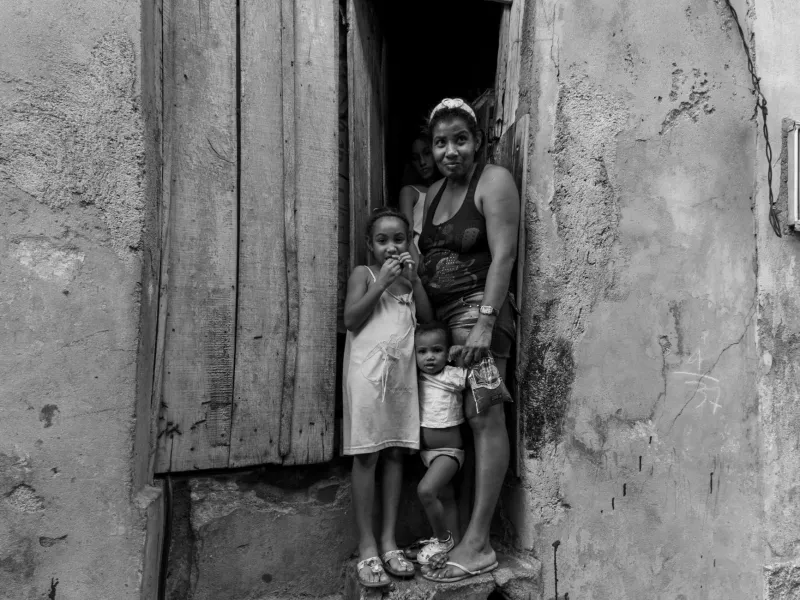
By the time Earl retired in 2001, he had produced more than fourteen thousand photographs documenting rural Black communities across the Deep South — sharecropper settlements, one-room barbershops, church picnics, front porches, school yards, and funeral processions. Communities that had no professional chronicler. Places that would have disappeared entirely from the visual record if a garbage man hadn't been paying attention.
Today, a significant collection of his work lives in the Library of Congress. Getting it there was almost as unlikely as making it in the first place.
 Photo: Library of Congress, via pennwatch.org
Found in the Trash, Made into Art
Earl didn't start out as a photographer. He started out as a man who couldn't stand to see useful things thrown away.
Sometime in the early 1970s, he pulled a battered Argus C3 camera from a trash can on his route in Macon, Georgia. The shutter was sticky and the lens had a hairline crack running through the lower left corner. He took it home, oiled what he could, and started shooting.
Film was a problem. New rolls were a luxury he couldn't reliably afford on a sanitation worker's wages. So he developed a system. He kept a mental catalog of which neighborhoods discarded camera supplies — holiday seasons were particularly good, when families upgraded their equipment and tossed the old stuff. He learned to work with expired film, understanding how age shifted contrast and color in ways that textbook photographers were trained to avoid. He didn't avoid them. He leaned into them.
The result was a visual signature that no formal training would have produced: a warmth, a slight grain, a quality of light that felt like memory itself. Critics would later describe his work as having "the texture of recollection." Earl would have told you it was just what expired Kodak looked like when you didn't have a choice.
The Superpower Nobody Wanted
There's something that professional photographers talk about called "subject awareness" — the subtle shift that happens when someone notices a camera. People straighten up. Expressions change. The natural moment closes like a flower at dusk.
Earl Dupree almost never encountered this problem.
A garbage man is functionally invisible in American social life. He arrives early, moves quickly, and people look through him rather than at him. When Earl walked through a neighborhood with a camera hanging around his neck, most people assumed it was some piece of work equipment they didn't need to understand. He wasn't a journalist. He wasn't a government photographer. He was the trash man, and the trash man was simply part of the landscape.
What he captured because of this was extraordinary. Unguarded moments at community gatherings. Elders on porches who had never in their lives posed for a photograph. Children playing in the dirt with an ease that a stranger with a camera bag and a press credential would have instantly interrupted. The communities he photographed didn't perform for him. They simply lived, and he quietly recorded it.
He also had access that money couldn't buy. Decades on the same routes meant relationships. People knew Earl. They waved him in. They offered him sweet tea. They let him stay.
What the Professionals Missed
By the 1980s, several of the communities Earl had been photographing since the early seventies were disappearing. Young people moved north. Old houses were demolished. Churches were consolidated. The physical and social geography of rural Black life in the South was being quietly erased, and the mainstream photographic establishment — focused on cities, on politics, on the dramatic — was largely elsewhere.
Earl kept showing up on Tuesdays and Fridays.
He had no darkroom, so he relied on drugstore processing for years, then taught himself to develop film in his bathroom using chemicals he ordered from a catalog. He stored his prints in shoeboxes, labeled by year and county, stacked in a spare bedroom that his wife eventually insisted he call "the archive" because it sounded more dignified than "the mess."
He never submitted work to galleries. He never entered competitions. He showed his photographs to family, to neighbors, occasionally to the communities he'd photographed when he passed through. That was enough for a long time.
The Shoeboxes Find Their Way
The story of how Earl's archive reached the Library of Congress is itself a study in unlikely paths. A graduate student researching rural Southern demographics in the late 1990s heard about a sanitation worker in Macon who had "a lot of old pictures." She drove out to meet him expecting a handful of snapshots. She spent three days going through shoeboxes.
The preservation effort that followed took years and involved archivists, historians, and more than a few arguments about how to classify work that didn't fit neatly into any existing photographic tradition. Earl attended the formal acquisition ceremony in Washington wearing the same quiet, slightly bemused expression he wore in every photograph taken of him. He seemed genuinely puzzled by the fuss.
When a journalist asked him what he thought his photographs meant, he said he didn't know about meaning. He said he just didn't want things to disappear without someone writing them down. He happened to write them down with a cracked lens and expired film.
What Scarcity Taught the Rest of Us
Earl Dupree's story sits uncomfortably alongside the conventional narrative of artistic achievement — the one that involves training, resources, recognition, and a clear upward arc. His arc was invisible for thirty years. His resources were literally garbage. His recognition came so late that he spent most of his career without any.
And yet the archive he built is irreplaceable. Historians of the American South consider it among the most significant documentary records of rural Black life in the latter half of the twentieth century. Not because of what Earl had, but because of what he didn't — and what that lack forced him to see, and become, and quietly preserve.
The odds, by any reasonable measure, were never in his favor. He beat them anyway. He just didn't make any noise about it.