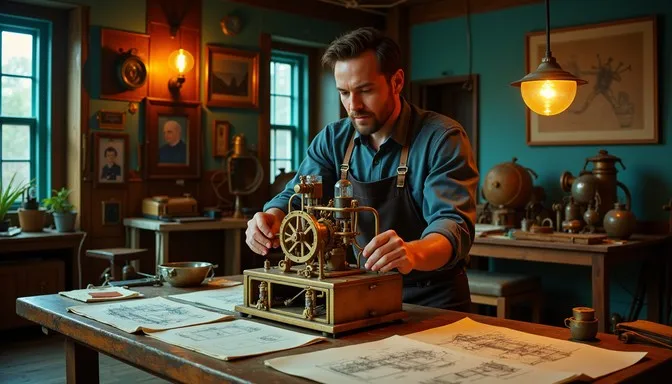
Photo: inventor workshop makeshift tools improvised machinery vintage American, via images.stockcake.com
There's a version of the invention story that gets told a lot. It involves a well-funded lab, a team of trained engineers, and a eureka moment that arrives on schedule. It's a satisfying story. It's also, historically speaking, not the most common one.
The more common story involves someone who couldn't afford the proper tools, couldn't access the right materials, and had no institutional support — and who, because of all that, was forced to think in a direction that nobody with resources had ever needed to consider.
Here are five Americans who proved that having less can sometimes be the only condition under which genuinely new things get made.
1. The Tin Can Irrigation System That Fed a Region
In the summer of 1934, with the Dust Bowl stripping topsoil from the southern Plains and drought turning farmland into powder, a sharecropper named Cyrus Alderman was trying to keep a small vegetable plot alive in western Oklahoma. He had no access to the irrigation equipment that larger operations used. He had no money to buy pipe or fittings. What he had was a pile of discarded tin cans and a problem that was going to kill his family's food supply if he didn't solve it.
 Photo: Cyrus Alderman, via images.squarespace-cdn.com
Over the course of two weeks, Alderman punched holes in cans at calculated intervals, connected them with lengths of salvaged rubber tubing, and built a gravity-fed drip system that delivered water directly to the base of each plant rather than broadcasting it across open soil where it evaporated almost immediately. He didn't know the word for what he'd built. Agricultural engineers who later examined his system called it a primitive but functional implementation of subsurface drip irrigation — a technique that would not enter mainstream agricultural practice for another thirty years.
A county extension agent photographed the system in 1935 and submitted it to a federal drought relief program that was documenting adaptive farming practices across the region. Alderman's design, simplified and scaled, became a template for small-plot water conservation programs across three states. He received no patent and no payment. But the system he built from garbage fed people who would otherwise have gone hungry, and the principle behind it still runs through modern precision agriculture.
2. The Teenager Who Accidentally Invented a Genre
In 1954, a seventeen-year-old named Delroy Simms was living in a cramped apartment on the South Side of Chicago with a secondhand guitar that had a cracked body and a pickup that buzzed with interference from the building's electrical wiring. He couldn't afford to fix it. He couldn't afford a new one.
 Photo: Delroy Simms, via live.staticflickr.com
What he could do was experiment with the buzz.
By wrapping a segment of steel wire around part of the pickup magnet and adjusting the tension, Simms discovered he could control the interference and produce a sustained, dirty distortion that his guitar wasn't supposed to be able to make. He started playing around it, then playing through it, then building chord progressions specifically designed to use it.
Musicians who heard him play in church basements and on back porches in the mid-1950s described the sound as unlike anything they'd encountered. Simms never recorded commercially and never sought credit for the technique. But the guitarists who heard him and borrowed his approach — some knowingly, some by osmosis — carried a version of that sound into recording studios across Chicago and Memphis. Musicologists who have traced the genealogy of electric guitar distortion in American popular music consistently find their way back to a cluster of South Side players in the mid-fifties who were working with equipment too broken to behave itself.
The genre those sounds helped build is worth billions of dollars annually. Delroy Simms died in 1991 having never owned a guitar that worked properly.
3. The Kitchen Table Prosthetic That Outperformed the Hospital Version
In 1947, a machinist named Rudolph Kranz lost three fingers on his right hand in a factory accident in Pittsburgh. The prosthetic options available to him were expensive, functionally limited, and designed for a generic hand rather than the specific demands of his work. He couldn't afford the better models. He went back to his kitchen table and started building his own.
 Photo: Rudolph Kranz, via images.findagrave.com
Kranz had spent twenty years working with metal. He understood tolerances and leverage and the mechanics of grip in a way that the medical device manufacturers of the 1940s — who were primarily designing for appearance and basic function — did not. Over eighteen months, he developed a partial-hand prosthetic using aluminum salvaged from aircraft manufacturing scrap that allowed him to return to precision machining work. The key innovation was a spring-tension mechanism he designed to mimic the natural resistance of a finger joint, which existing prosthetics didn't attempt.
He filed a patent in 1949 and spent the next decade trying to interest medical device companies in the design. Most weren't interested. One small manufacturer in Ohio licensed the spring-tension mechanism in 1958. That mechanism, refined through several generations of engineering, appears in some form in partial-hand prosthetics still manufactured today. Kranz made enough from the licensing agreement to pay off his house. He considered it a fair outcome.
4. The Washboard Synthesizer
In 1968, a music teacher in rural Louisiana named Viola Tureaud was trying to teach rhythm and percussion to students in a school that had no budget for instruments. She had a stack of old washboards and a room full of kids who needed something to hit.
What started as a classroom improvisation became something more systematic. Tureaud began attaching different materials to the washboards — bottle caps, strips of metal, sections of rubber — at positions she mapped by ear to produce specific pitches and timbres when struck. Over two school years, she developed a set of modified washboards that could produce a range of sounds broad enough to accompany the vocal music her students were already learning.
A recording of her students performing at a regional school event in 1970 circulated among music educators in the Gulf Coast region. Several of the techniques she'd developed for attaching resonant materials to a washboard surface showed up, with modification, in experimental percussion instruments built by musicians in New Orleans through the 1970s. The direct line from her classroom to any specific commercial instrument is impossible to draw cleanly. The influence is real.
Tureaud taught in the same school for thirty-one years. She never claimed any credit for what her washboards inspired. She said she was just trying to give her students something to do with their hands.
5. The Cardboard Lens That Helped Map the American West
In 1887, a surveyor's assistant named Hector Briggs was working a government land survey in the territory that would become Arizona when the glass lens on his theodolite — the instrument used to measure horizontal and vertical angles — cracked beyond use. Replacement parts were weeks away. The survey couldn't wait.
Briggs spent three days experimenting with materials he had available: cardboard, beeswax, a piece of polished tin, and a fragment of glass from a broken bottle. What he produced was not a proper optical lens. It was a pinhole-style aperture that, when combined with the remaining functional components of the theodolite, allowed him to take angle measurements accurate enough to continue the survey.
The official survey report, filed with the General Land Office in 1888, noted the improvised instrument as a curiosity. An engineer at the GLO who reviewed the report wrote a short technical note about the pinhole aperture modification and circulated it among field survey teams as a potential emergency procedure. That note was referenced in at least two subsequent survey reports from teams that used variations of Briggs's improvisation when equipment failed in the field.
The maps produced from those surveys — including portions of Briggs's original work — formed part of the official cartographic record used in Arizona's territorial and early statehood administration. The cardboard lens that made them possible is not in any museum. It didn't survive the desert.
The Thing That Connects Them
None of these five people set out to change anything. They set out to solve a problem they had right now, with the materials in front of them, because they didn't have the option of waiting for better ones.
That constraint — the hard wall of not enough — is what sent each of them in a direction that trained professionals with proper equipment had no reason to explore. The tin can drip system worked because Alderman couldn't afford pipe. The distortion sound existed because Simms couldn't afford a working guitar. The cardboard lens mapped a territory because Briggs couldn't wait for glass.
Scarcity is a brutal teacher. But every now and then, it's the only teacher that gets you somewhere new.