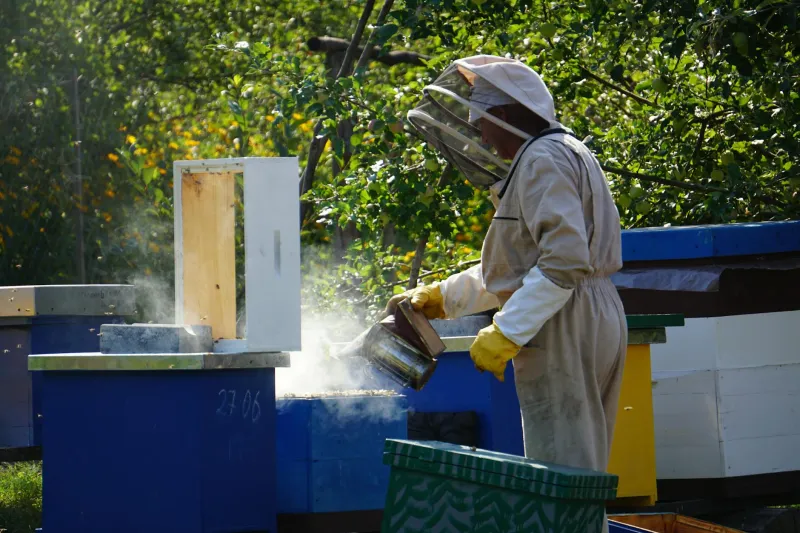
The Hillside Laboratory
Ann Lovell never owned a microscope, never published a paper, and never set foot in a university lecture hall. What she had was forty acres of Kentucky mountain land, a dozen weathered hive boxes, and the kind of bone-deep understanding that comes from watching the same patch of earth through forty seasons.
 Photo: Ann Lovell, via www.hodgkinsinternational.com
When her bees started dying in 2006, she didn't call the agriculture extension office. She pulled up a lawn chair and watched.
When the Experts Had No Answers
Across America, beekeepers were reporting the same nightmare: healthy colonies simply vanishing overnight, leaving behind honey, larvae, and queen bees with no workers in sight. Scientists dubbed it Colony Collapse Disorder and launched million-dollar research initiatives. Teams of entomologists deployed electron microscopes, genetic sequencing, and climate modeling.
Meanwhile, Lovell sat in her backyard with a notebook and a thermos of coffee, documenting what she saw.
"The university folks kept talking about mites and viruses," she recalls. "But I noticed something else. My bees were getting confused about direction. They'd leave the hive and circle back like they forgot where they lived."
While researchers focused on pathogens, Lovell was tracking behavior patterns that didn't fit any textbook.
The Discovery That Wasn't Supposed to Happen
Lovell's breakthrough came from the kind of accident that makes PhD advisors cringe. She'd been moving hives away from her neighbor's new cell tower when she noticed something remarkable: the relocated colonies thrived while others continued to collapse.
"I wasn't trying to prove anything," she says. "I just needed to get them away from the noise."
But Lovell's "noise" theory led her to systematically document electromagnetic interference patterns around her property. Using nothing more than a compass and careful observation, she mapped correlations between colony health and proximity to power lines, radio towers, and wireless equipment.
Her handwritten logs, kept in composition notebooks from the local dollar store, revealed patterns that million-dollar studies had missed.
When the Establishment Came Calling
For three years, Lovell's findings circulated only among local beekeepers. Then Dr. Sarah Chen, a USDA entomologist conducting field research in Kentucky, heard about the woman whose bees "never got lost."
 Photo: Dr. Sarah Chen, via i.ytimg.com
Chen expected to find another well-meaning amateur with theories about moon phases or organic remedies. Instead, she discovered documentation more thorough than most peer-reviewed studies.
"Ann had mapped electromagnetic fields across six counties using techniques I'd never seen," Chen later wrote. "She was correlating bee flight patterns with solar activity, tracking queen behavior in relation to power grid fluctuations, and documenting recovery rates with scientific precision."
Lovell's methods were unorthodox but undeniably effective. She'd developed interventions that consistently prevented colony collapse in her apiaries while neighboring operations continued to fail.
The Science Behind the Success
What Lovell had discovered through intuition, researchers would later confirm through controlled studies: electromagnetic radiation disrupts bee navigation systems. The insects rely on Earth's magnetic field for orientation, and modern wireless infrastructure creates interference patterns that can disorient entire colonies.
But Lovell went further than identifying the problem. She'd developed practical solutions.
Her "grounding protocol" involved strategic placement of metal mesh around hives to reduce electromagnetic interference. Her "orientation training" gradually acclimated bees to new locations by moving hives incrementally rather than relocating them suddenly. Her "recovery feeding" used specific sugar concentrations that helped disoriented bees rebuild their navigational abilities.
None of these techniques appeared in any manual, but they worked.
From Backyard to National Policy
By 2012, Lovell's methods were being tested at agricultural research stations across the country. The USDA incorporated her electromagnetic interference protocols into official beekeeping guidelines. Extension offices that once ignored her calls were now sending graduate students to study her techniques.
The farmer's daughter who never finished high school had solved a crisis that stumped the scientific establishment.
The Wisdom of Watching
Lovell's story reveals something profound about how innovation happens. While researchers focused on reductionist approaches—isolating variables, controlling conditions, testing hypotheses—she practiced what scientists call "systems thinking" without ever learning the term.
"You can't understand bees by studying dead ones under a microscope," she explains. "You have to watch them live their lives."
Her success came from patient observation, pattern recognition, and the kind of intimate knowledge that develops over decades of daily interaction. She understood her bees not as research subjects but as neighbors.
Today, Lovell's protocols have helped restore bee populations across North America. Commercial beekeepers use her electromagnetic interference maps. University research programs study her documentation methods. Agricultural policy reflects her findings.
And in the Kentucky hills where it all started, Ann Lovell still pulls up her lawn chair each morning to watch her bees navigate the world she helped them reclaim.