The Secret Mailroom: Five Letters That Accidentally Steered America
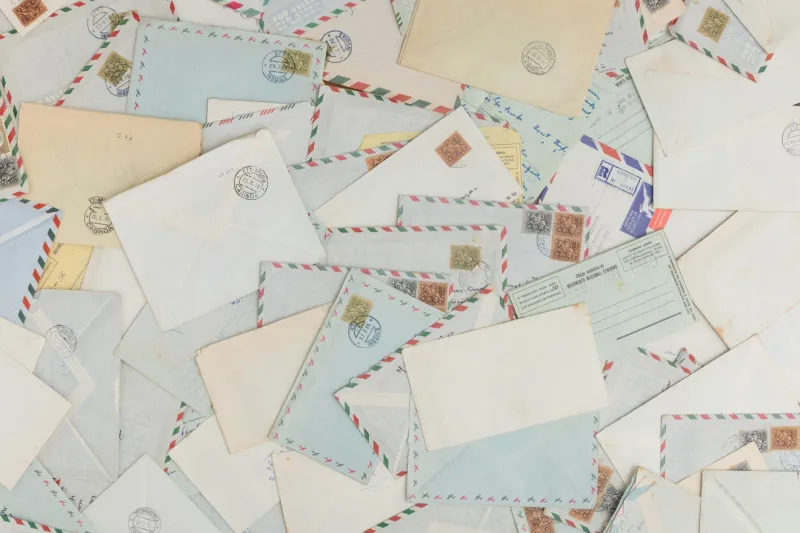
When Ordinary People Moved Mountains
In the age of instant messages and viral tweets, it's easy to forget when a single letter could change the course of history. But between the 1880s and 1960s, some of America's most significant moments began with unlikely pen pals—people who had no business writing to each other, yet somehow found ways to make their words count.
These weren't diplomatic cables or corporate memos. They were handwritten notes from seamstresses to senators, teenagers to presidents, prisoners to power brokers. What they lacked in official channels, they made up for in timing, insight, and the kind of desperate clarity that only comes from having nothing left to lose.
The Farm Girl Who Rewrote the New Deal
In 1934, sixteen-year-old Clara Hancox was helping her family survive the Dust Bowl when she did something unprecedented: she wrote directly to President Franklin Roosevelt. Not to his staff, not through proper channels, but to him personally—addressing the envelope simply to "Mr. Roosevelt, The White House."
 Photo: Franklin Roosevelt, via media.automobili10.it
Clara's letter wasn't a request for help. It was a detailed critique of New Deal agricultural policies, written from the perspective of someone actually living through their consequences. She explained how government crop subsidies were helping large farms while destroying small family operations like hers. Her letter included specific suggestions for policy changes, backed by observations from her family's failed attempts to comply with federal programs.
Roosevelt, who received thousands of letters daily, normally left correspondence to his staff. But something about Clara's letter caught his attention. Maybe it was her direct writing style, or her practical solutions to problems his advisors had only theorized about. Whatever the reason, he wrote back personally and forwarded her suggestions to his agricultural secretary.
Six months later, the Agricultural Adjustment Act was modified to include provisions that directly addressed Clara's concerns. The changes helped save thousands of small farms across the Midwest. Clara never knew her letter had influenced policy—she only learned about it decades later when presidential archives were opened to researchers.
The Prisoner Who Freed a Movement
In 1963, while civil rights leaders debated strategy in conference rooms, Clarence Johnson was writing letters from a Mississippi jail cell. Johnson, arrested during a voter registration drive, had been corresponding with Senator Jacob Javits of New York—a relationship that began when Johnson read about Javits's support for civil rights legislation.
Johnson's letters weren't pleas for personal help. Instead, they were detailed reports about voting rights violations in Mississippi, written by someone experiencing them firsthand. His correspondence provided Javits with specific examples and legal precedents that northern senators needed to understand the reality of southern resistance.
Johnson's most influential letter described the exact mechanisms local officials used to prevent Black citizens from registering to vote. His detailed account of "literacy tests" and poll taxes, written with the precision of someone who had witnessed these tactics repeatedly, became the foundation for key provisions in the 1965 Voting Rights Act.
Javits later credited Johnson's letters as "the most important intelligence I received" during the civil rights era. Johnson served three years in prison, but his correspondence helped create the legal framework that eventually made such imprisonments impossible.
The Seamstress Who Sparked Innovation
Mary Chen had been working in New York garment factories for fifteen years when she wrote to Thomas Edison in 1889. Her letter wasn't fan mail—it was a business proposal. Chen had noticed that Edison's new electric lighting systems created dangerous working conditions in textile mills, where fabric dust could ignite near exposed bulbs.
 Photo: Thomas Edison, via cdn.futura-sciences.com
Chen's letter included detailed drawings of an enclosed lighting system she had designed, along with calculations showing how her design would reduce fire risks while improving working conditions. She proposed that Edison's company manufacture her invention, offering to license the patent for a small percentage of sales.
Edison, intrigued by the practical nature of Chen's proposal, invited her to demonstrate her invention at his laboratory. Her enclosed lighting system worked exactly as described, solving a safety problem that had plagued industrial facilities since electric lighting was introduced.
Edison's company licensed Chen's design, and her safety lighting system became standard in factories across America. Chen used her royalties to open her own garment shop, becoming one of the first Chinese-American women to own a manufacturing business in New York.
The Teenager Who Stopped a War
In 1962, during the Cuban Missile Crisis, seventeen-year-old Peter Kowalski was more worried about his pen pal in Moscow than about nuclear war. Peter and Alexei Petrov had been corresponding since 1960 as part of a student exchange program. When tensions escalated in October 1962, Peter decided to write directly to Premier Khrushchev.
 Photo: Nikita Khrushchev, via image.shutterstock.com
Peter's letter was remarkable for its simplicity. He didn't discuss politics or policy. Instead, he wrote about his friendship with Alexei, describing their shared interests in astronomy and baseball. He asked Khrushchev to consider how many similar friendships would be lost if the crisis escalated to war.
The letter reached Khrushchev through diplomatic channels, arriving at a crucial moment when the premier was reconsidering his position. According to declassified Soviet documents, Khrushchev was moved by Peter's letter and shared it with his advisors during final negotiations.
While Peter's letter wasn't the only factor in resolving the crisis, Khrushchev later cited it as a reminder that the stakes involved real people, not just political abstractions. The premier personally responded to Peter, beginning a correspondence that continued until Khrushchev's death.
The Widow Who Changed Medicine
After her husband died from a misdiagnosed illness in 1923, Margaret Sullivan wrote to every medical school in America. Her letters weren't complaints—they were detailed case studies of diagnostic errors, based on her husband's medical records and her own research into similar cases.
Sullivan's correspondence with Johns Hopkins Medical School led to a revolutionary change in medical education. Her systematic analysis of diagnostic mistakes convinced administrators to establish America's first formal program for studying medical errors. The program, funded partly by Sullivan's own donations, became the model for modern medical review processes.
Sullivan's letters transformed how doctors learn from mistakes, creating systems that have saved countless lives. She never attended medical school, but her influence on medical education rivals that of any professor.
The Power of the Unexpected Voice
These five correspondences succeeded because they came from unexpected sources with nothing to lose and everything to gain. Their authors weren't constrained by institutional politics or professional reputations. They could afford to be direct, honest, and innovative in ways that official communications rarely allowed.
In each case, the recipient was powerful enough to act on the information but removed enough from the situation to see it clearly. The combination of insider knowledge and outsider perspective created opportunities for change that formal channels had missed.
Today's digital communication makes such personal correspondence nearly impossible. But these stories remind us that the most important messages often come from the most unlikely messengers—and that sometimes the best way to reach power is simply to write as if you belong there.