From a Cotton Field to a Castle: The Unlikely Empire of America's First Self-Made Female Millionaire
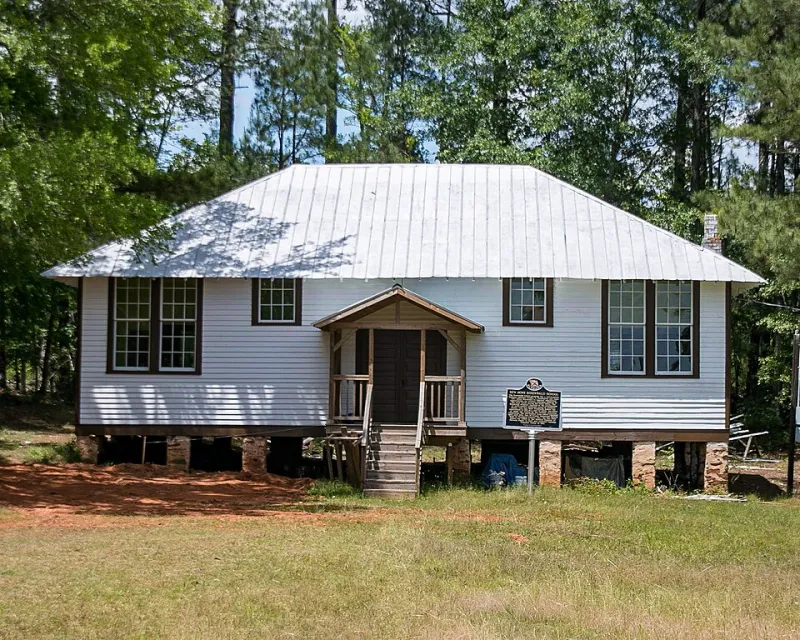
Photo: Cyntata2672, CC BY-SA 4.0, via Wikimedia Commons
From a Cotton Field to a Castle: The Unlikely Empire of America's First Self-Made Female Millionaire
There's a particular cruelty to the math of Sarah Breedlove's early life. Born in 1867 on a Delta, Louisiana cotton plantation — the first child in her family born free after emancipation — she inherited a freedom that came with almost nothing attached to it. No land. No money. No schoolhouse within reasonable reach. Just the brutal, relentless labor of sharecropping under a Mississippi Delta sun that didn't much care who you were or what you dreamed about.
By the time she was seven, both of her parents were dead from yellow fever. By twelve, she was an orphan in the full and official sense, moving in with a married sister whose husband made her life miserable enough that she married a man named Moses McWilliams at fourteen just to get out from under his roof. By twenty, Moses was dead too — the cause is disputed by historians, but the result was not — and Sarah was alone with a two-year-old daughter named Lelia, eighteen dollars in savings, and a country that had very specific ideas about what a Black widowed woman with no education was allowed to become.
The answer, according to that country, was: not much.
Sarah Breedlove had other plans.
The Long Walk Before the Run
For the next two decades, she did what survival required. She moved to St. Louis, where her brothers had settled and found work as barbers. She took in laundry — heavy, back-breaking work that paid barely enough to keep Lelia in school while she scrubbed other people's clothes in a tin tub. She was in her mid-thirties before anything changed, and when it did, it started not with a business plan but with a scalp condition.
The relentless physical labor, the poor diet, the stress — it had all taken a toll on her hair, which was thinning and breaking in patches. She was desperate for a solution, and she started experimenting. She tried products on the market. She talked to her brothers, who understood hair chemistry from their barbering work. And somewhere in that process — in a story she told with slight variations over the years, sometimes including a dream, sometimes not — she landed on a formula. A pomade. Something that worked.
She began selling it door to door in Denver in 1905, having relocated there partly for her health and partly for a fresh start. She was thirty-seven years old. She had almost no capital. And she was competing in a market dominated by white-owned companies that had no interest in the specific needs of Black women's hair.
That last part turned out to be her edge.
The Gamble That Changed Everything
What separated Sarah Breedlove — who had by now married Charles Joseph Walker and begun calling herself Madam C.J. Walker, a title that projected exactly the kind of authority the world had never offered her — was not just a good product. Plenty of people had good products. What she had was an understanding of her customer that no competitor could replicate, because she was her customer.
 Photo: Madam C.J. Walker, via i.abcnewsfe.com
She knew what it felt like to want something that didn't exist for you. She knew the particular combination of pride and frustration that came with being a Black woman in early twentieth-century America, where beauty standards were designed around everyone else. And she built her business not just around a pomade but around a philosophy: that Black women deserved to feel beautiful, that their hair was worth caring for, and that the women selling them that care should look like them.
The Walker Method, as it became known, was sold by a network of agents — Black women trained by Madam Walker herself, who earned commissions and built their own economic independence in the process. At a time when Black women's employment options were almost exclusively domestic service, Walker created something that looked a lot like a career path. By some estimates, she eventually employed more than forty thousand women across the country.
She moved her headquarters to Indianapolis in 1910, built a factory, opened a beauty school, and kept expanding. She took the kind of risks that would make a cautious person's stomach drop — reinvesting aggressively, traveling constantly to demonstrate her products, building relationships with Black newspapers and churches that gave her access to communities no mainstream advertising could reach.
The Empire She Built in Plain Sight
By the time Madam C.J. Walker died in 1919, she was worth an estimated $600,000 — the equivalent of several million dollars today, and enough to make her the wealthiest Black woman in America and, by most historical accounts, the first self-made female millionaire in the country regardless of race. She had built a thirty-four-room mansion called Villa Lewaro on the Hudson River in New York. She had testified before the NAACP. She had pledged money to anti-lynching legislation at a time when that required real courage.
 Photo: Villa Lewaro, via www.thoughtco.com
She had also, in the years before her death, begun to understand that her empire was bigger than hair. She used her platform and her wealth to advocate loudly for Black Americans at a moment when advocacy came with genuine personal risk. She wasn't just a businesswoman. She was proof of concept — living, breathing evidence that the system designed to contain her had miscalculated.
What the Odds Actually Were
It would be easy to tell the Madam C.J. Walker story as a simple triumph-over-adversity narrative, the kind where hardship is a backdrop and success is the payoff. But that flattens something important. The adversity wasn't just background noise. It was the actual classroom.
She understood her customers because she had been them. She understood the value of economic independence because she had lived without it. She understood how to reach communities that felt ignored because she had been ignored herself. Every door that was closed to her taught her something about how doors worked — and eventually, she stopped knocking and started building her own.
The plantation in Delta, Louisiana, where Sarah Breedlove was born is long gone. But the company she built, the network of women she empowered, and the blueprint she laid down for Black entrepreneurship in America outlasted everything that was supposed to stop her. That's not an accident. That's what happens when someone refuses to let the odds be the last word.