Two Dollar Telescopes and a Million-Dollar Mistake: How a Night Shift Worker Found What the Pros Missed
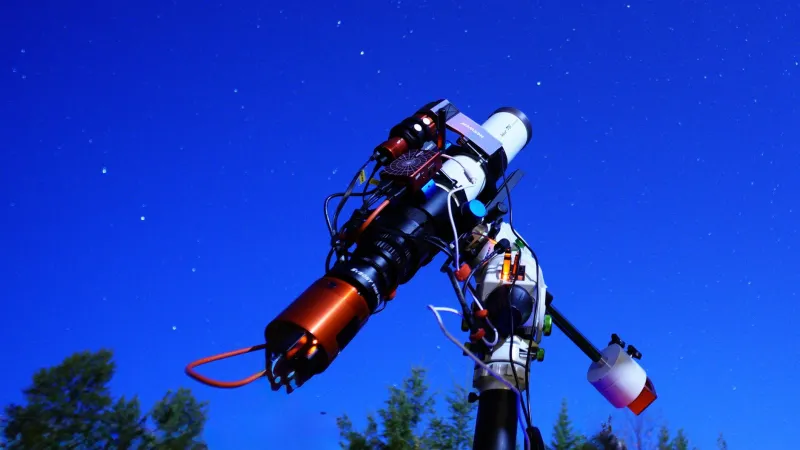
The observatory sat at the end of a gravel driveway in the American Southwest, and by the standards of modern astronomy, it was a joke. A corrugated metal shed on a rotating base. A telescope assembled partly from salvage parts. A notebook kept by hand, in pencil, by a man who spent his nights not scanning the heavens but sweeping floors and checking locks at a warehouse across town.
By the standards of the professionals, none of it should have worked.
And yet on a cold October night, working between his shifts, that man recorded something the multi-million-dollar instruments at coastal universities had catalogued a dozen times and dismissed a dozen times. It took the establishment three years to admit he was right.
The Unwritten Rule of Who Gets to Look Up
American science has always had an uncomfortable secret: for most of its history, it preferred its discoverers to have the right paperwork. Degrees. Affiliations. A university email address that ends in .edu. The amateur astronomer occupied a strange, semi-respected limbo — welcomed at star parties, tolerated at conferences, quietly discounted when the real work of discovery was handed out.
The night watchman knew this. He had written to observatories early in his hobby, asking questions about variable stars, and received replies that were polite the way form letters are polite. So he stopped asking and started watching. Every clear night after his shift ended, he'd drag himself to the shed, align his scope, and log whatever crossed his patch of sky.
His advantage wasn't equipment. It was time and attention. The big telescopes were oversubscribed — astronomers bidding for precious hours, pointing them at fashionable targets, chasing grants. Nobody was funding patient, repetitive observation of 'boring' objects. Nobody, that is, except a man whose boss paid him to stay awake anyway.
The Night It Clicked
The discovery itself was almost anticlimactic. A flicker in a star's brightness that the catalogs called a known variation. The watchman's notes disagreed — the rhythm was wrong, the period off, the pattern inconsistent with anything on record. He cross-checked against archived data available publicly, and found that the big facilities had recorded the same anomaly. And filed it away as noise.
He spent months confirming it before he worked up the nerve to say anything. This time, when he wrote to an institution, he attached data so clean it couldn't be waved off. A junior researcher — someone low enough on the ladder to still remember being an outsider — looked at the numbers and felt her stomach drop. The amateur was right. The professional consensus was wrong.
What followed was a masterclass in institutional face-saving. The eventual paper acknowledged his contribution in careful, minimal language. The press release celebrated the observatory. The man in the metal shed got a paragraph.
What the Shed Represents
Here's why his story matters beyond one star: the bottleneck in discovery is rarely intelligence or even equipment anymore. It's attention. The professionalized scientific enterprise, for all its power, rations attention by credential. If you lack the paperwork, your observations need to be dramatically better than a professional's just to be considered.
The watchman's data was dramatically better — because his situation was. He watched the same patch of sky with obsessive regularity. He wasn't chasing the next grant cycle. He had nothing to protect. In an economy of scientific attention, he was the only one making a long-term bet on an unfashionable corner of the universe.
There's a lesson in that for anyone told their circumstances disqualify them. His night job, the thing that marked him as an outsider, was precisely what gave him his edge — steady hours, quiet mornings, and a working relationship with staying alert while the world sleeps.
The Sky Doesn't Check Credentials
The best ending to this story is that it isn't rare. Amateur astronomers still discover comets, supernovae, and asteroids at a rate that embarrasses the professionals. Citizen science projects now deliberately harness the very people institutions once ignored, because someone finally ran the numbers and realized the math: a thousand patient amateurs beat ten oversubscribed telescopes at certain kinds of looking.
The man in the metal shed never got the job title. He kept the warehouse job, kept the observatory, kept the pencil notebooks. When asked once whether he felt slighted, he shrugged in a way that suggested he'd made his peace with the arrangement long ago. The stars didn't care who found them, he said. Somebody was going to notice eventually.
He just made sure that somebody was him — one shift, one night, one flicker at a time.