The Night Shift Genius Who Cracked MIT's Toughest Puzzles While Everyone Slept
The 3 AM Epiphany
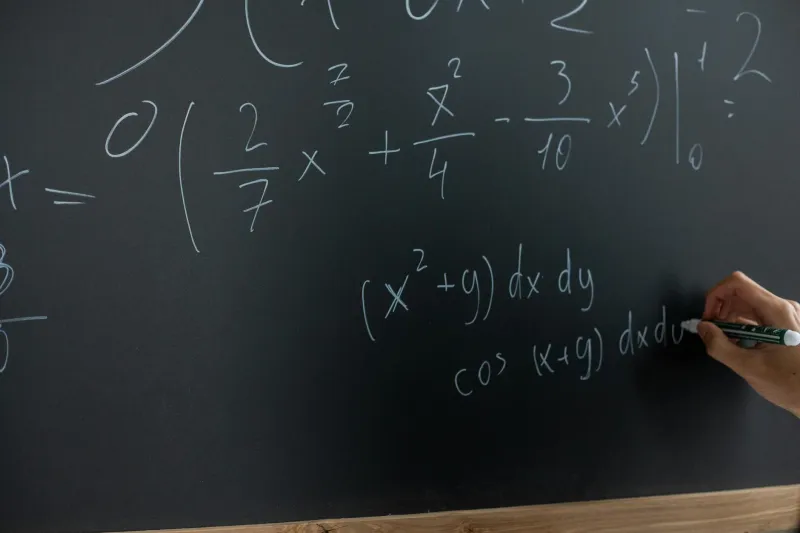
While MIT's brightest minds slept in their dorm rooms, George Carruthers pushed his cleaning cart down the empty corridors of Building 32. The mathematics department's chalkboards were covered in half-erased equations, abandoned problems that had stumped graduate students for weeks. Most custodians would simply wipe them clean and move on. George had a different routine.
He'd stop, study the symbols, and think.
By morning, those same boards would display elegant solutions written in careful handwriting below the original problems. The professors assumed their star pupils had returned for late-night study sessions. They had no idea their janitor had been quietly solving problems that carried million-dollar research implications.
From Dropout to Discovery
George's story began in rural Alabama, where he'd dropped out of high school at 16 to help support his family after his father's death. Math had always come naturally to him—he could calculate crop yields and lumber measurements in his head faster than most people could with pencils—but formal education felt like a luxury his family couldn't afford.
Decades later, when economic necessity brought him north to Boston, the only job he could find was cleaning offices. The irony wasn't lost on him that he'd spend his nights in the same buildings where other people pursued the education he'd never had.
But proximity, as it turned out, was everything.
The Accidental Education
MIT's halls became George's informal classroom. During his eight-hour shifts, he absorbed fragments of lectures echoing from seminar rooms, glimpsed complex diagrams on whiteboards, and overheard passionate debates about theoretical frameworks. What started as casual curiosity evolved into serious study.
He began checking out textbooks from the public library, using his break time to sit in empty lecture halls and work through problem sets. The cleaning cart became his mobile desk, stocked with notebooks where he'd sketch out his own approaches to the mathematical challenges he encountered.
The breakthrough came on a Tuesday night in November. A graduate student had left a particularly stubborn topology problem on the board—something about manifold structures that had the entire advanced seminar stuck. George studied it during his dinner break, then again while mopping the adjacent hallway.
By 4 AM, he'd identified the error in the class's approach and worked out an elegant proof. He wrote his solution in small, neat letters at the bottom of the board.
When Genius Meets Recognition
Professor Linda Martinez arrived early that morning to find her students clustered around the board in animated discussion. The solution was not only correct—it was more efficient than anything in the published literature.
"Who wrote this?" she asked.
The students exchanged confused glances. None of them had returned to the classroom after the previous day's session.
Security footage revealed the truth. There was George, working steadily at the board while his mop bucket sat forgotten in the corner.
What happened next changed everything.
The Invisible Network
George's story wasn't unique. Across America's elite institutions, a quiet network of custodial staff, security guards, and maintenance workers had been absorbing knowledge and making connections that their day-shift counterparts missed entirely.
There was Maria Santos, who discovered a flaw in a chemistry lab's experimental setup while cleaning beakers at Stanford. Her observation prevented a potentially dangerous reaction and led to a revised safety protocol.
And James Wright, whose late-night conversations with insomniac physics students at Caltech helped him develop an intuitive understanding of quantum mechanics that he later applied to solve engineering problems in his family's small manufacturing business.
The Real Variable
These stories reveal something profound about talent and opportunity. George didn't suddenly become brilliant when he started working at MIT—he'd always had the intellectual capacity for advanced mathematics. What changed was his access to problems worth solving and tools for solving them.
The traditional narrative suggests that genius finds a way, regardless of circumstances. But George's experience points to a different truth: genius needs proximity. It needs exposure to challenging questions, access to resources, and—perhaps most importantly—permission to engage with ideas that society has deemed "above your station."
Beyond the Ivory Tower
Professor Martinez didn't just acknowledge George's contribution—she advocated for him. Within six months, MIT had created a special program allowing staff members to audit courses and use research facilities during off-hours. George became the program's first participant, eventually co-authoring papers and speaking at conferences.
His work on geometric optimization now influences everything from computer graphics to architectural design. But he still remembers those nights when his greatest challenge was convincing himself he had the right to think about the problems written on those boards.
"The hardest part wasn't solving the equations," he reflects. "It was believing I deserved to try."
Today, George holds an honorary doctorate from MIT and runs a foundation that provides educational opportunities for working adults. His cleaning cart sits in a place of honor in his office—a reminder that the most unlikely beginnings can lead to extraordinary destinations.
Sometimes the biggest breakthrough is simply recognizing that intelligence doesn't respect job titles, and the most profound discoveries happen when we expand our definition of who gets to participate in the conversation.