The Night Cleaner Who Mopped Floors and Memorized Equations
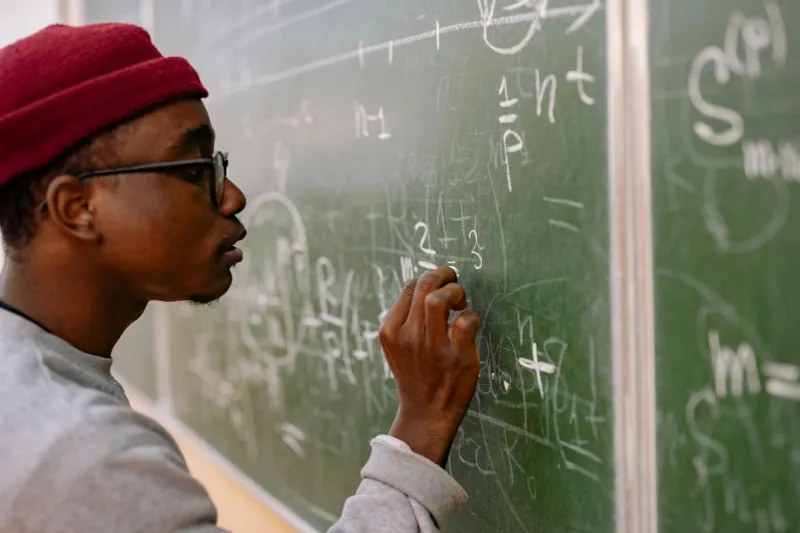
The Invisible Genius
Every night at 11 PM sharp, Richard Martinez would punch his timecard at the California Institute of Technology and begin his eight-hour journey through some of the most brilliant minds on Earth. But while the professors went home to their suburban houses and the graduate students retreated to their cramped apartments, Martinez stayed behind with his mop bucket and an insatiable curiosity that would eventually rewrite the rules of quantum mechanics.
For two decades, Martinez was invisible. Faculty members would nod politely as he emptied their trash cans. Students barely glanced up from their laptops as he cleaned around them in the library. But Martinez was watching, listening, and most importantly, learning.
"I never meant to become a mathematician," Martinez later recalled. "I just couldn't help myself."
The Accidental Education
Martinez had dropped out of high school at 16 to help support his family after his father's construction accident. College seemed like a luxury reserved for other people's children. But when he landed the custodial job at CalTech in 1995, he found himself in the middle of an intellectual feast.
Every whiteboard told a story. Every discarded draft paper contained fragments of revolutionary thinking. While other custodians might have erased the equations without a second thought, Martinez began photographing them with a disposable camera he bought at the campus bookstore.
"At first, it was just curiosity," he explained. "These symbols looked like art to me. But then I started noticing patterns."
He would spend his breaks in the library, checking out textbooks that the professors had assigned to their classes. When the library closed, he'd continue reading under the fluorescent lights of empty classrooms, his cleaning supplies forgotten in the corner.
The Breakthrough Nobody Saw Coming
By 2010, Martinez had taught himself calculus, linear algebra, and quantum mechanics. He was auditing lectures by hiding in the back of amphitheaters, taking notes in the margins of recycled paper. His apartment walls were covered with his own mathematical explorations—attempts to understand and extend the work he encountered each night.
Then came the morning that changed everything.
Dr. Sarah Chen, a quantum computing researcher, had been struggling with a particular proof for months. She'd filled three whiteboards with failed attempts, each one ending in mathematical dead ends. Frustrated, she'd left the mess for the cleaning crew and gone home.
When she returned the next morning, she found her whiteboards not just clean, but filled with a completely different approach to her problem. Someone had not only understood her work but had found an elegant solution that had eluded her team of PhD students.
From Shadows to Spotlight
Chen installed a hidden camera, convinced that one of her colleagues was playing an elaborate prank. Instead, she discovered Martinez, working through her equations with the focused intensity of someone who had been thinking about these problems for years.
"I watched him for three nights," Chen remembered. "He wasn't just copying or guessing. He understood the mathematics at a level that some of my graduate students never reach."
The confrontation was awkward. Martinez thought he was in trouble for touching the whiteboards. Chen thought she was looking at the most unconventional genius she'd ever encountered.
"I asked him where he learned quantum mechanics," Chen said. "He pointed around the room and said, 'Here. From all of you.'"
The Theorem That Changed Everything
What happened next reads like academic fiction. Chen convinced the mathematics department to let Martinez audit classes officially. Within two years, he had earned his GED and was enrolled as a special student. By 2015, he had published his first paper—a theorem that provided a new framework for quantum error correction.
The Martinez-Chen Theorem, as it's now known, has become fundamental to quantum computing research. It solved a problem that had stumped researchers for decades, and it came from someone who had learned mathematics by mopping floors and staying curious.
"The beautiful thing about math," Martinez often tells his students now, "is that it doesn't care about your credentials. It only cares about whether you're right."
The Professor Who Started in the Basement
Today, Dr. Richard Martinez is a tenured professor at CalTech, the same institution where he once worked nights. His office is in the same building he used to clean, though now he's the one leaving equations on whiteboards for others to ponder.
His story has become legend among the graduate students, but Martinez insists it's not about individual brilliance. "I had twenty years of the best mathematics education in the world," he says. "I just got it from a different angle than most people."
He still keeps his old custodial uniform in his office closet, not as a reminder of where he came from, but as proof that genius can emerge from anywhere—even from the shadows where nobody thinks to look.
Sometimes the most extraordinary discoveries come from the most ordinary circumstances. Sometimes the person who changes everything is the one nobody notices until it's impossible to ignore them.