From Hay Bales to Gallery Walls: The Farmhand Who Painted His Way to the Smithsonian
The Canvas Nobody Wanted
In 1947, a twenty-three-year-old farmhand named Samuel Hartwell was mixing house paint with blackberry juice in the corner of a tobacco barn in rural Kentucky. His canvas was the back of a feed sack, stretched tight over a wooden frame he'd cobbled together from scrap lumber. The subject: his neighbor's weathered hands holding a newborn calf.
Hartwell had never set foot in an art class. He'd never seen the inside of a museum. Hell, he'd barely made it through eighth grade before his father pulled him out to work the family's struggling farm. But something in those calloused hands cradling new life demanded to be captured, and Hartwell was the only one crazy enough to try.
Today, that same painting hangs in the Smithsonian American Art Museum, part of a collection that art critics now call "one of the most authentic voices of rural American experience." The journey from that makeshift studio to the nation's most prestigious walls is a story of stubborn creativity, accidental genius, and what happens when raw talent has nowhere to hide.
Learning to See in the Dark
Hartwell's artistic education began at 4:30 AM, when he'd rise before dawn to milk cows. While his hands worked automatically, his eyes wandered—cataloging the way morning light crept through barn slats, how shadows pooled in the hollows of his father's face, the exact shade of red that appeared when his mother's hands emerged from hot dishwater.
"I was always looking," Hartwell would later tell an interviewer. "Daddy thought I was daydreaming, but I was studying. The way dust motes moved in sunbeams. How corn silk caught the light. I couldn't stop seeing things."
The problem was materials. Art supplies cost money the Hartwells didn't have. So Samuel improvised. He ground clay from the creek bed for browns and ochres. He boiled elderberries for deep purples. Charcoal from the woodstove became his drawing medium. When he couldn't afford proper brushes, he used chicken feathers, corn husks, even his own fingers.
The Barn Studio
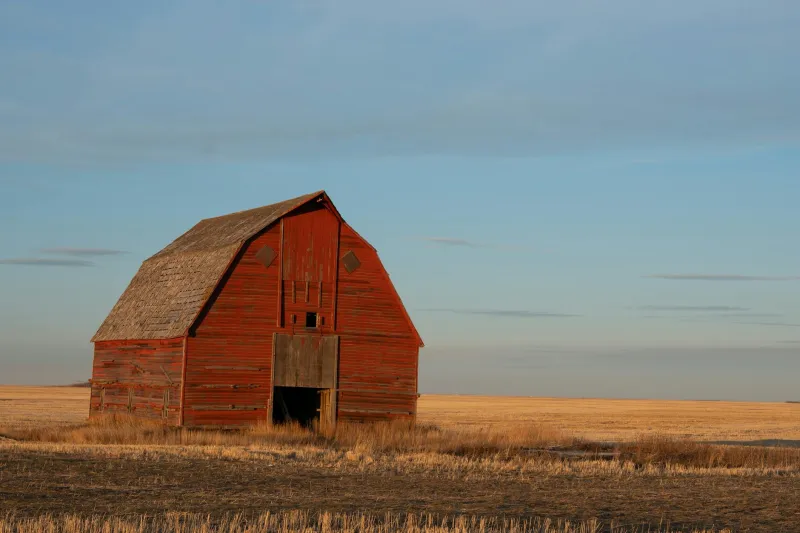
By 1950, Hartwell had converted a corner of the old tobacco barn into his studio. He worked by kerosene lamp after finishing his farm chores, often painting until midnight. His subjects were what surrounded him: weathered farmers, prize-winning livestock, the geometric patterns of plowed fields, the faces of neighbors who'd lived hard lives with quiet dignity.
His technique was entirely self-developed. He'd never heard of chiaroscuro or color theory, but he understood light and shadow from years of watching sunrise creep across pastures. He painted thick, building up layers like sediment, creating textures that seemed to breathe off the canvas.
"Sam painted like he farmed," remembered his sister Mary. "Patient, methodical, but with this underlying intensity. Like he was racing against time."
The Accidental Discovery
Hartwell might have remained unknown if not for a flat tire in 1962. Art dealer Margaret Chen was driving through Kentucky, heading to a folk art exhibition in Louisville, when her car broke down near the Hartwell farm. While waiting for a tow truck, she wandered into the barn looking for a phone.
What she found instead were dozens of paintings stacked against the walls—portraits of farmers that seemed to glow with inner life, landscapes that captured something essential about rural America that she'd never seen in galleries.
"I knew immediately I was looking at something extraordinary," Chen recalled. "The technical skill was remarkable, but it was more than that. These paintings had soul. They told stories that nobody else was telling."
Chen convinced Hartwell to let her take three paintings to show colleagues in New York. Within six months, he had his first gallery exhibition.
Recognition at Last
The art world's response was immediate and polarizing. Some critics dismissed Hartwell as a "primitive" whose work lacked sophistication. Others recognized a master of American realism whose isolation had preserved something authentic that formal training might have diluted.
"Hartwell paints America as it actually is, not as we imagine it to be," wrote critic James Morrison in 1963. "His farmers aren't romanticized pastoral figures—they're real people with dirt under their fingernails and worry lines around their eyes. This is documentary work disguised as fine art."
The Smithsonian acquired its first Hartwell painting in 1965. By the time of his death in 1998, his work was in collections across the country, and art historians were studying his unique techniques—methods born from necessity and refined through decades of solitary practice.
The Legacy of Looking
Hartwell never left Kentucky. Even as his paintings sold for thousands, then tens of thousands of dollars, he continued farming and painting in that same converted barn. Success didn't change his subjects—he painted the same neighbors, the same landscapes, the same honest faces that had first captured his attention.
"People ask me why I never moved to New York or studied with the masters," he said in a 1987 interview. "But I had everything I needed right here. The light was the same light Rembrandt painted by. The human stories were the same ones that have always mattered."
Today, art schools teach courses on "outsider art" and "regional realism," often using Hartwell's work as the gold standard. His story reminds us that great art doesn't require pedigree or permission—sometimes it just requires the courage to see what's in front of you and the stubbornness to keep painting it, one barn light at a time.
The farmhand who mixed paint from berries proved that the most authentic voices often come from the most unexpected places. Sometimes the best way to join the conversation is to ignore it entirely and just keep working.