The Fired Schoolteacher Who Stayed After Class — and Invented the Toy in 100 Million Homes
When the Bell Rang for the Last Time
Ole Kirk Christiansen stood in the empty classroom, staring at the chalkboard he'd never write on again. It was 1916, and the school board in Billund, Denmark had made their decision clear: his services were no longer needed. At 25, with a wife and growing family to support, Christiansen faced the kind of professional dead end that breaks most people.
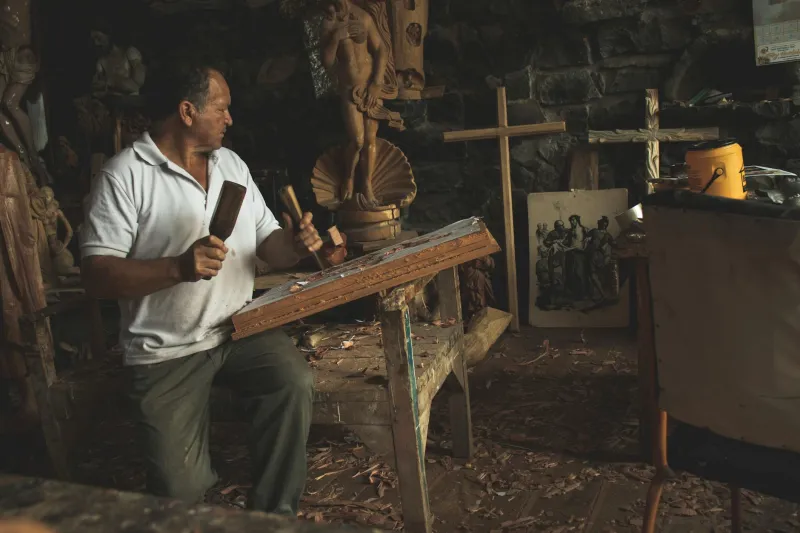
But instead of looking for another teaching position, Christiansen did something unexpected. He went home, cleared out his garage, and started whittling.
The Classroom That Never Closed
What began as a desperate attempt to make ends meet quickly revealed itself as something deeper. Christiansen had always been the teacher who stayed late, the one who found creative ways to help struggling students grasp difficult concepts. Now, unemployed and uncertain, he channeled that same patient creativity into carving wooden toys.
His first creations were simple: wooden ducks, cars, and pull-along animals. But Christiansen approached toy-making with a teacher's mindset. He didn't just want to create something that looked nice—he wanted to build something that would genuinely engage a child's imagination and learning.
"Only the best is good enough," became his motto, a philosophy that would have sounded familiar to any of his former students.
From Scrap Wood to Something Special
The early years were brutal. Christiansen's carpentry workshop barely kept his family afloat, and his wooden toys were just a side business. In 1924, a fire destroyed his workshop entirely. Most entrepreneurs would have seen this as the final sign to quit. Christiansen saw it as an opportunity to rebuild better.
He reconstructed his workshop and doubled down on toy production. By 1932, he had coined the name that would become legendary: "LEGO," derived from the Danish phrase "leg godt," meaning "play well." What he didn't know was that in Latin, "lego" means "I put together"—a coincidence that would prove prophetic.
The Lesson That Changed Everything
Christiansen's breakthrough came from observing how children actually played with his toys. Like any good teacher, he watched, listened, and adapted. He noticed that kids were more engaged when they could build something themselves, when they could take apart and reassemble, when they could create rather than just manipulate.
In 1947, Christiansen became one of the first toy manufacturers in Denmark to invest in plastic injection molding machines. His wooden toys were beautiful, but plastic offered something revolutionary: the ability to create interlocking pieces with precise tolerances. Other manufacturers were skeptical—plastic toys seemed cheap, temporary. Christiansen saw potential.
The Interlocking Revolution
The first plastic LEGO bricks appeared in 1949, but they weren't the interlocking marvels we know today. Those early bricks could stack but didn't grip together. It wasn't until 1958 that Christiansen's son, Godtfred, perfected the internal tube system that made LEGO bricks lock together with satisfying precision.
This wasn't just a mechanical improvement—it was an educational philosophy made manifest. Each brick could connect to any other brick in countless combinations. Children weren't just playing; they were engineering, problem-solving, creating.
The Teacher's Greatest Lesson
By the time Ole Kirk Christiansen died in 1958, his "classroom" had expanded far beyond Billund. LEGO bricks were teaching children across Europe about spatial relationships, engineering principles, and creative thinking. The fired schoolteacher had become one of the most influential educators in history—he just wasn't standing in front of a chalkboard anymore.
Today, there are roughly 400 billion LEGO elements in the world, enough for every person on Earth to own about 50 bricks. The average American child will spend 5,000 hours playing with LEGO bricks—more time than they'll spend in any single grade of school.
Building Blocks of Success
What makes Christiansen's story remarkable isn't just the global success of LEGO—it's how he transformed professional rejection into creative fuel. When the school system said his teaching methods weren't needed, he didn't abandon his core belief in learning through play. He just found a different way to reach children.
The company Christiansen built from garage scraps now generates over $5 billion in annual revenue. LEGO remains privately held by his family, still headquartered in the small Danish town where a dismissed teacher once wondered what to do with his life.
The Lesson Lives On
In classrooms around the world today, teachers use LEGO bricks to teach everything from basic math to advanced robotics. Ole Kirk Christiansen's greatest invention wasn't just a toy—it was a teaching tool that continues to prove his original insight: the best learning happens when children are actively building, creating, and discovering.
Sometimes the most important lessons come not from staying in the classroom, but from having the courage to build your own.