The Man Who Hit Bottom at 32 and Reinvented How We See the Planet
The Edge of Everything
In 1927, Buckminster Fuller stood on the shores of Lake Michigan, broke and broken. At 32, he'd been kicked out of Harvard twice, failed at multiple businesses, and watched his first daughter die of pneumonia in a poorly heated house he couldn't afford to fix. His wife was pregnant with their second child, and he had no job, no prospects, and no idea how he'd provide for his family.
Standing there in the Chicago cold, Fuller seriously considered ending it all. Instead, he made a decision that would change architecture, environmentalism, and how humanity thinks about our planet forever.
"I decided to make myself a good case history," he later wrote, "of what the little, unknown individual might be able to do on behalf of all humanity."
The Experiment Begins
Fuller called it his "experiment" — treating his own life as a laboratory to see what one person could accomplish if they stopped trying to make money and started trying to solve problems. It was either the most naive decision imaginable or the most brilliant. Turned out to be both.
He started by asking big questions. Why did buildings have to be heavy? Why did maps distort the world? Why did we think of Earth as an endless resource instead of a closed system hurtling through space?
These weren't the questions of someone trying to climb the corporate ladder. They were the questions of someone with absolutely nothing to lose.
Doodling His Way to Revolution
Fuller's breakthrough came through what looked like elaborate doodling. While others drew straight lines and right angles, he sketched triangles and spheres, fascinated by how nature built things — honeycombs, crystals, soap bubbles — with maximum strength using minimum materials.
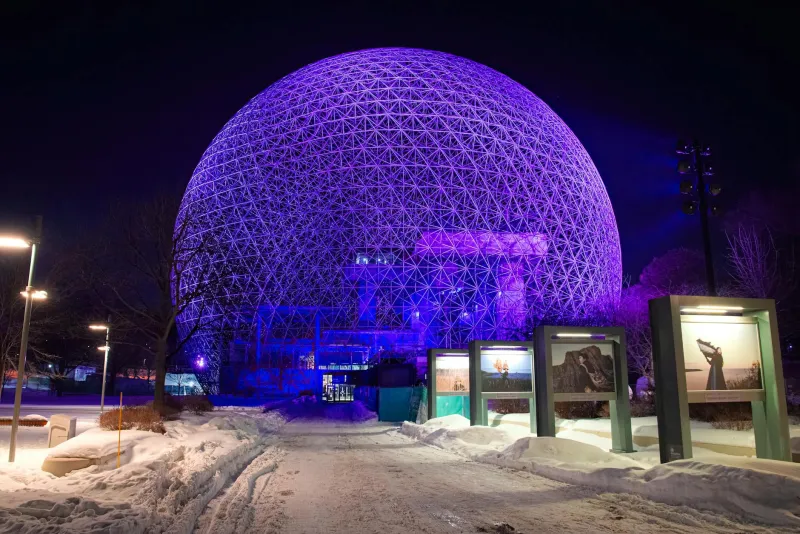
In 1947, twenty years after his lakeside revelation, Fuller patented the geodesic dome. The design was so simple it seemed almost silly: a sphere made of triangles that got stronger as it got bigger. Traditional buildings got heavier and more expensive as they expanded. Fuller's domes did the opposite.
The U.S. military took notice immediately. Here was a structure you could airlift anywhere in the world and assemble in hours. The Marines started using geodesic domes in the Korean War. By the 1960s, there were more than 300,000 geodesic domes around the globe.
The View from Space
But Fuller's real revolution wasn't architectural — it was conceptual. In 1968, when Apollo 8 sent back the first photographs of Earth from space, Fuller had been preparing people for that moment for decades. He'd coined the term "Spaceship Earth" back in the 1950s, arguing that we needed to think of our planet not as an unlimited resource, but as a closed system with finite supplies.
"We are not going to be able to operate our Spaceship Earth successfully," he warned, "nor for much longer, unless we see it as a whole spaceship and our fate as common."
This was environmental thinking before environmentalism had a name. While others saw the Earth as something to conquer, Fuller saw it as something to maintain — like the life support system on a spacecraft.
The Outsider's Advantage
Fuller never fit the mold of a traditional academic or businessman. He spoke in his own invented vocabulary, calling himself a "comprehensive anticipatory design scientist" and describing his work in terms that made perfect sense to him and confused almost everyone else.
But that outsider status became his superpower. While architects were trained to think about buildings, Fuller thought about systems. While engineers focused on making things work, Fuller focused on making them work efficiently. While businessmen chased profits, Fuller chased what he called "livingry" — technology that supported life rather than destroyed it.
The Doomsday Prophet Who Chose Hope
By the 1960s, Fuller had become something unprecedented: a celebrity futurist. He gave lectures at universities across the country, published books with titles like "Operating Manual for Spaceship Earth," and inspired a generation of architects, environmentalists, and technologists.
Steve Jobs called him one of his heroes. The hippie movement adopted his geodesic domes as symbols of alternative living. NASA consulted him on space habitat design. Not bad for a suicidal dropout.
The Long View
Fuller died in 1983, but his ideas feel more relevant than ever. Climate change has made "Spaceship Earth" thinking essential for survival. His efficiency obsession anticipated our current focus on sustainability. His geodesic domes inspired everything from soccer balls to the molecular structure of buckyballs (named in his honor).
Most importantly, his story proves something that sounds almost too good to be true: sometimes the best thing that can happen to you is losing everything you thought you wanted.
The Experiment Continues
Standing on that lakeside in 1927, Fuller couldn't have imagined that his decision to become an "experiment" would influence how we see our planet, design our buildings, and think about our future. He just knew that traditional paths had failed him completely.
Sometimes the most revolutionary thing you can do is stop trying to fit in and start trying to figure out what the world actually needs. Fuller spent 56 years after his crisis moment doing exactly that — doodling in the margins of conventional thinking until those doodles became blueprints for a different kind of future.
The dropout who couldn't make it at Harvard ended up teaching the whole world how to think.