The Maestro Who Heard Symphonies in Silence — and Changed Music Forever
When the Music Stopped Coming Through His Ears
Imagine being a professional basketball player and slowly going blind. Or a chef gradually losing taste and smell. For Ludwig van Beethoven, the nightmare was equally cruel: a composer watching his hearing slip away, note by note, until the world went silent.
By his early thirties, Beethoven could barely make out conversations. By forty, he needed special hearing devices that looked like small trumpets pressed against his ears. By fifty, even those were useless. Yet during these years of increasing deafness, he composed some of the most powerful music ever written — works that still make audiences gasp two centuries later.
How do you write symphonies when you can't hear them? How do you conduct orchestras when the sound is trapped inside your head? Beethoven's story isn't just about overcoming disability — it's about what happens when someone refuses to let circumstances define what's possible.
The Cruel Irony Nobody Saw Coming
Beethoven first noticed something was wrong around 1798, when he was 28. Conversations became muffled. High notes on the piano started disappearing. For someone whose entire identity revolved around sound, it felt like a death sentence.
He tried everything — cold baths, hot baths, special diets, primitive hearing aids made of metal and wood. Nothing worked. The hearing loss was progressive and irreversible, probably caused by lead poisoning from the wine he drank or an autoimmune condition.
In 1802, at age 32, Beethoven wrote what's now called the "Heiligenstadt Testament" — essentially a suicide note addressed to his brothers. "It was impossible for me to say to people: 'Speak louder, shout, for I am deaf,'" he wrote. "How could I possibly admit an infirmity in the one sense which ought to be more perfect in me than others?"
But he didn't end his life. Instead, he made a decision that would change music history: he would learn to hear with his mind instead of his ears.
The Revolution That Happened in Silence
Here's where Beethoven's story gets remarkable. As his physical hearing deteriorated, his musical imagination exploded. The compositions he wrote during his deaf years weren't just good — they were revolutionary.
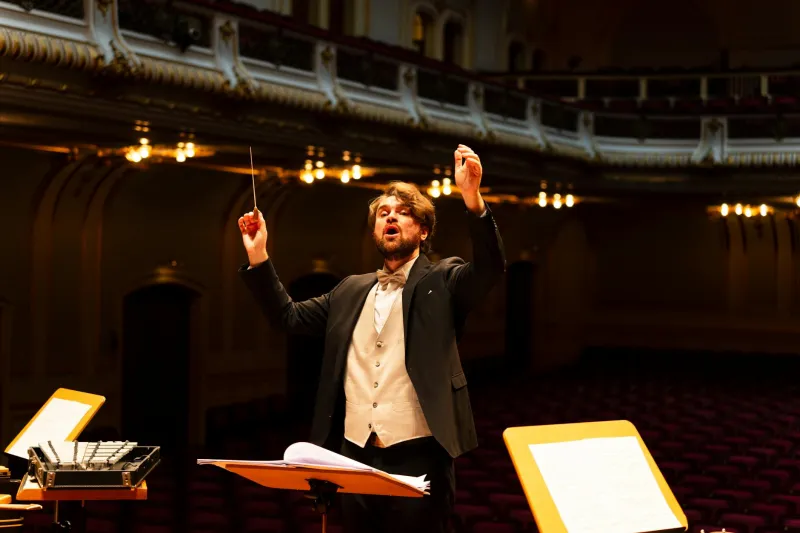
His Ninth Symphony, completed when he was almost completely deaf, broke every rule about how long symphonies should be and what they should sound like. The "Ode to Joy" finale remains one of the most recognizable pieces of music ever written. When it premiered in Vienna in 1824, Beethoven stood on stage conducting, completely unaware that the audience behind him was giving him a standing ovation until someone turned him around to see it.
His late string quartets, written in total deafness, are considered by many musicians to be the most profound chamber music ever composed. These weren't the works of someone making do with a disability — they were the products of a mind that had learned to hear music in an entirely new way.
How He Heard What We Couldn't
Beethoven developed techniques that seem almost supernatural. He would bite down on a metal rod connected to his piano, feeling the vibrations through his jawbone and skull. He pressed his ear against the piano's soundboard. He learned to "hear" by watching the movements of musicians' fingers and instruments.
But the real breakthrough was mental. Beethoven had trained his musical memory so thoroughly that he could compose entire symphonies in his head, hearing every instrument, every harmony, every dynamic change without a single external sound.
He carried conversation books where people would write to communicate with him, but these books also became musical notebooks. He'd sketch melodic ideas, work out harmonies, and develop entire musical arguments on paper — then hear them perfectly in his mind.
The Impossible Performance
The premiere of his Ninth Symphony in 1824 captured everything extraordinary about Beethoven's journey. He insisted on conducting despite being stone deaf. The orchestra had a backup conductor standing beside him, but Beethoven was the one the audience watched.
As the music unfolded — music he had written but would never hear performed — the audience was transfixed. When it ended, the applause was thunderous. Beethoven, still facing the orchestra, had no idea. Caroline Unger, one of the soloists, had to physically turn him around to see the audience on their feet, many crying.
It was a moment that perfectly captured the impossible thing he had accomplished: a deaf man had just conducted music that moved an entire concert hall to tears.
What the Silence Taught Him
Beethoven's deafness didn't just change how he composed — it changed what he composed. Free from the limitations of what instruments could actually play easily, or what audiences expected to hear, his late works became increasingly experimental and emotionally intense.
He wrote music that existed purely in the realm of imagination, unconstrained by practical concerns about performance or popular taste. Some of his late piano sonatas and string quartets wouldn't be fully appreciated until decades after his death, when musicians finally caught up to what his silent mind had conceived.
The Legacy of Learning to Hear Differently
Beethoven died in 1827, having spent more than half his career in progressive deafness. But those silent years produced works that are still performed daily around the world. His story became proof that creativity doesn't just survive limitations — sometimes it thrives because of them.
Today, when musicians study Beethoven's late works, they're not just learning notes on a page. They're experiencing what one human mind could accomplish when it refused to accept that losing one sense meant losing everything.
The maestro who heard symphonies in silence didn't just overcome his disability — he used it to discover musical territories that no one with perfect hearing had ever imagined. Sometimes the biggest obstacles don't block the path to greatness. They just force you to find a better way forward.